Our brief visit to Ushuaia was quite special among our stops
in South America owing to the prior reading of Lucas Bridges’ book, The Uttermost Part of the Earth, which
chronicles the many trials of what eventually became the Anglican settlement of Ushuaia, Tierra del Fuego. Lucas Bridges (1874–1949) was among the first non-natives to be born in
Ushuaia. Like his father, Thomas (1842–1898), he became a self-taught
anthropologist in the way he built rapport with both the canoe-dwelling Yaghans of Tierra's southern waterways and the guanaco-hunting Onas of
the plains on Tierra's main island to the north. They'd both establish and maintain lifelong friendships with people of these tribes.
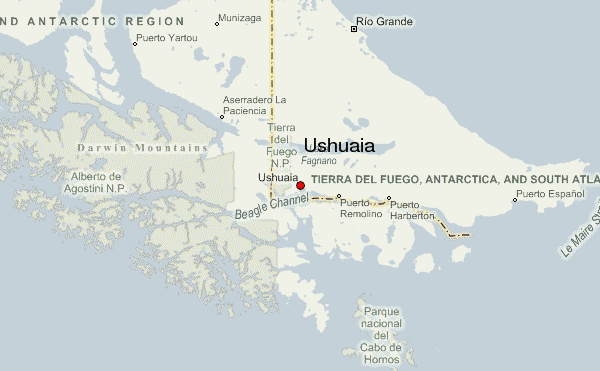
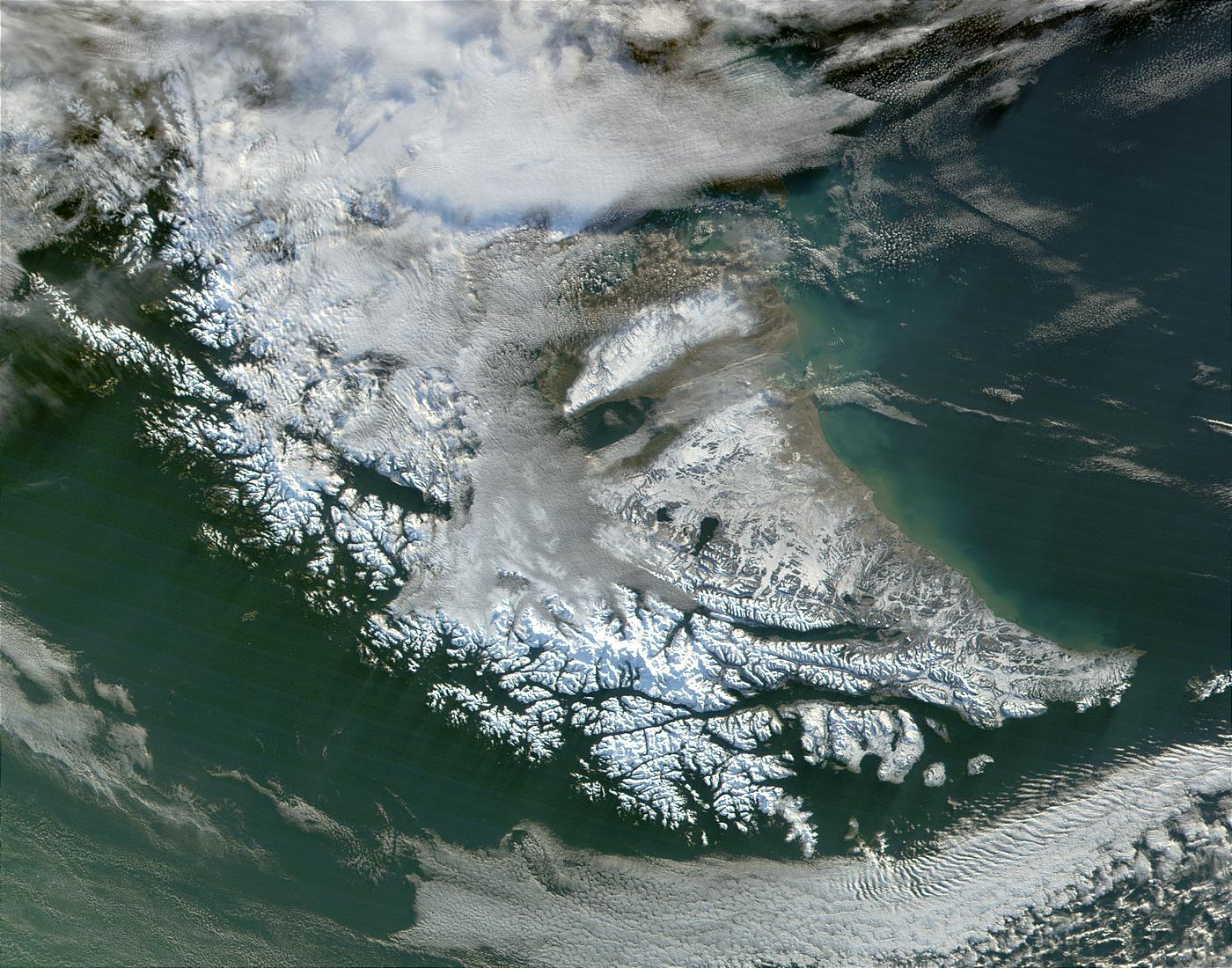
Tierra del Fuego is the landmass and archipelago comprising the right hook at South America’s southern tip, where it juts out into the Atlantic. The name—Fire Land—was given by Magellan, who, among the other seafarers seeking shortcuts through lower South America, would see smoke plumes rising from the coastlines all about them, as well as from hidden sources in the water. This was undoubtedly haunting to the sailors, but it was the native Yaghans who were in fear. Upon seeing these huge alien ships filled with large, bearded alien men they’d ignite these fires and get them smoking in order to alert other nearby Yaghans that something strange was up. The smoke along the shorelines was from wigwams, while the mysterious plumes over the water were from their canoes, where the Yaghans spent most of their time. They’d keep fires in there, protecting the boat with a layer of sand and rocks, in order to warm and dry after going for a swim to hunt. Their tendency to remain mostly naked all the time, although counter-intuitive, gave them the ability to warm and dry rapidly by these fires (#talkaboutshrinkage).
Thomas Bridges was at the ripe old age of 26 when
he was on the final leg of his momentous journey from England to Ushuaia, having departed
from the Falkland Islands armed with the Bible, a fluency in Yaghan, and a close
familiarity with the natives and their land. His task was to settle Ushuaia under the direction of the South American Mission Society, formed by Capt. Allen Gardiner, one of Thomas's predecessors. The name Ushuaia comes
from Yaghan, meaning westward-pointing
bay. Thomas would be the first to
successfully communicate and reach civility with the native Yaghans,
establishing an Ushuaian settlement in which his family, some fellow Brits, and many Yaghans would live harmoniously for years. His success owed largely to lessons from his predecessors’ fateful attempts, the most incredible of which is the story of Capt. Allen Gardiner.
 |
Artist's rendering of Gardiner, as he was discovered on
Picton Island. |
During Gardiner's 1850-51 mission to Tierra, he and all of his company died by starvation on the rocky coast of Picton Island, which sits in the eastern mouth of the Beagle Channel. This fate was lain by a severe miscalculation of provisions necessary, and was made worse by over-exposure, thieving natives, and an abnormally intense winter. Their story, ironically, was the spark that so strongly motivated follow-on attempts to carry out the holy duty. This inspiration came from their personal accounts...
In their final days, in spite of complete starvation and weakness, they were "happy beyond the poor compass of language to tell." They were in a state of bliss and gratefulness, ever faithful, witnessing their own demise. "Great and marvellous are the loving-kindnesses of my gracious God unto me. He has preserved me hitherto, and for four days, although without bodily food, without any feeling of hunger or thirst." That's Gardiner's last journal entry, several days before he died (read on). Quite an inspiring account, no matter what your faith.
 |
Male Yaghan fastening a sharpened
stone to complete a spear for hunting
sea lions. |
While the settlement of Tierra del Fuego sadly came with the eventual decimation of the native population via a cornucopia of epidemics, the story of the Bridges' settlement was a positive
one in that their interactions with the Yaghans were quite symbiotic. With his fluency in Yaghan and an altruistic
and leadership mentality, Thomas often played an important role as mediator,
both in conflicts among the natives (for instance, murder and theft among the
natives quickly became a thing of the past) and in conflicts between
the natives and other explorers, scientists, or militia coming from Europe. These foreign travelers often came
with the ignorant and completely false picture of the natives—of
cannibalizing, ruthless savages—painted for them by Darwin, Magellan, and
other early explorers. So these
travelers came armed and poised for battle. The settlers also successfully taught the natives the techniques for living off
the land. They had survived for
centuries, and probably even millennia, on sea lions, fish, birds, and shellfish; but the seasonality of these sources tested them to extremes, so this advent was very welcome.
The beauty of this region in itself is quite
breathtaking, but to know a bit of the story (kudos to Gavin for finding this
book) made it all the more enchanting. Our first siting of the Beagle Channel, which served as the Yaghan’s main
expressway, or of Mount Olivia, or Navarin Island, or the sea lions, all of
which made up the lifestyle, home, and food of the Yaghans, was captivating.
Daydreaming of being back in Hotel Antártida...
Some favorites from our trip:
 |
| Looking out over the Beagle Channel southeastward, with Ushuaia mostly hidden at the foot of the hill in the foreground, and Navarin Island across the channel. |
Sea lions! Thousands of them! While they almost disappeared after the city's
blow-up, the law forbidding their hunting saved their population.
 |
The remnants of a Yaghan wigwam on one of the islands in the channel,
with old shells, fish bones, etc. scattered all about. There are thousands
of these all over the shorelines of Tierra. |
 |
| Looking northeast from the same island towards a snow-shrouded Mt. Olivia. |
 |
| Same island, looking southeast across the island's colorful fields. |
 |
| Looking northwest (I think) In a valley north of Ushuaia, snowshoeing it. |
 |
| Joys of Ushuaia on the last night of our journey (Jeff skating circles around us). |